Delhi-Mumbai Expressway Real Estate Investment Guide: Opportunities, Connectivity & Future Growth
SEO Title: Delhi-Mumbai Expressway Real Estate Investment Guide
Meta Description: Explore how the Delhi-Mumbai Expressway is influencing real estate growth, connectivity and investment opportunities across emerging locations.
URL Slug: delhi-mumbai-expressway-real-estate-investment-guide
Primary Keyword: Delhi-Mumbai Expressway real estate
Secondary Keywords: Delhi-Mumbai Expressway property investment, real estate investment near Delhi-Mumbai Expressway, land investment near Gurgaon, Ghilot real estate, Rajasthan real estate investment, farmhouse investment near Gurgaon
Introduction
The development of major highways has always played an important role in shaping real estate markets. Better connectivity can improve accessibility, encourage commercial activity and increase interest in previously emerging locations. The Delhi-Mumbai Expressway is one such major infrastructure corridor that is attracting attention from businesses, investors and property buyers.
For real estate investors, the key question is not simply whether a property is close to an expressway. The more important question is whether the surrounding location has the right combination of connectivity, infrastructure, economic activity, residential demand and long-term development potential.
This guide explores the relationship between the Delhi-Mumbai Expressway and real estate investment, along with some important factors buyers should consider before investing.
Why Is the Delhi-Mumbai Expressway Important for Real Estate?
Infrastructure and real estate growth are closely connected. When travel becomes easier between major cities and economic hubs, surrounding areas can become more attractive for businesses and residents.
The Delhi-Mumbai Expressway connects the National Capital Region with Mumbai through a major high-speed road corridor. Its broader network also connects several important regions across North and Western India.
For property investors, improved road connectivity can potentially create opportunities in locations that are positioned along or near major access routes.
However, infrastructure alone does not guarantee property appreciation. Investors should evaluate the complete development ecosystem of a location.
1. Improved Connectivity Can Increase Location Attractiveness
One of the biggest advantages of major expressway infrastructure is improved accessibility.
For people looking at land or property outside established urban centres, travel time and road connectivity can be important considerations. Locations with access to major highways may become more convenient for commuting, business travel and weekend use.
For example, areas around Gurgaon and the broader NCR region are increasingly connected to major transportation corridors. This makes connectivity an important factor when comparing different real estate investment destinations.
2. Emerging Locations Can Attract Early Investors
Established real estate markets often have higher entry prices because infrastructure, commercial activity and residential demand are already developed.
Emerging locations can offer a different investment proposition.
When infrastructure is developing and commercial activity is expanding, investors may start evaluating land and property opportunities before an area becomes fully developed.
This does not mean every emerging location will deliver high returns. Instead, investors should identify areas where multiple growth factors are developing simultaneously.
These can include:
- Road and highway connectivity
- Industrial development
- Employment opportunities
- Nearby urban centres
- Commercial infrastructure
- Residential demand
- Planned infrastructure projects
- Availability of quality land and developments
3. Ghilot and the Growing Rajasthan Connection
Ghilot, Rajasthan is one location that has gained attention because of its connectivity to the NCR region and its growing industrial ecosystem.
Its position along the Delhi-Jaipur corridor and proximity to major road infrastructure makes it a location worth monitoring for investors interested in emerging real estate markets.
The combination of industrial activity, highway connectivity and relatively open surroundings can make locations such as Ghilot interesting for buyers looking beyond traditional city-centre real estate.
Investors should still conduct independent due diligence regarding land title, approvals, developer credentials, infrastructure and project-specific documentation before making any purchase decision.
4. Farmhouse Investment and Lifestyle Real Estate
Real estate investment is not limited to apartments and commercial properties.
Over the last few years, lifestyle-oriented developments such as farmhouse communities have become an option for buyers looking for a combination of land ownership, privacy, greenery and recreational use.
For buyers considering a farmhouse near the NCR region, accessibility becomes particularly important.
A location that provides convenient highway connectivity can make a weekend or second-home property more practical for owners travelling from Gurgaon, Delhi or nearby cities.
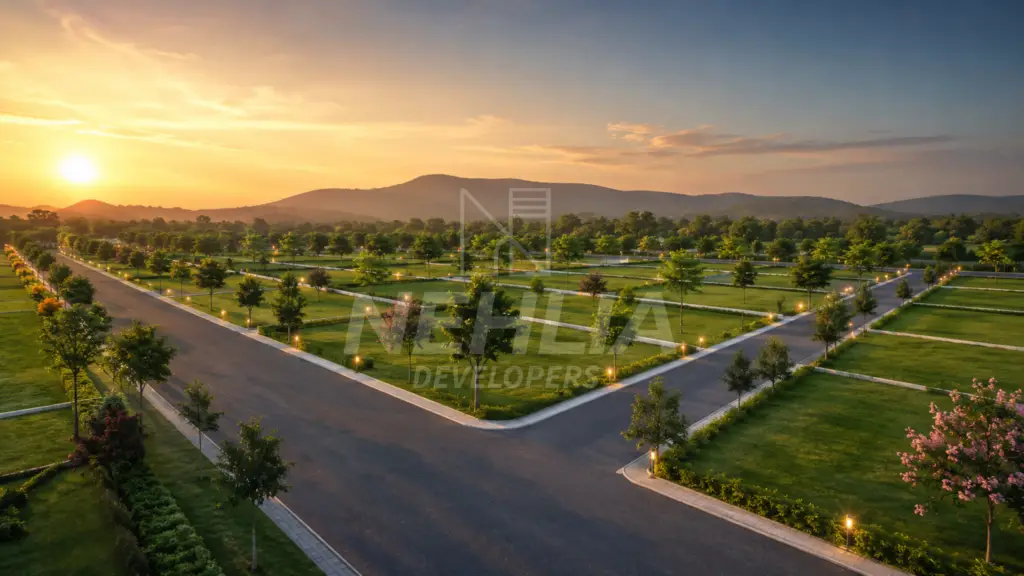
Developments such as Nehlia Santo Hills focus on this lifestyle segment, offering buyers an opportunity to explore luxury farmhouse community living in the Ghilot region.
For more information about Nehlia Developers and its projects, visit Nehlia Developers.
5. What Should Investors Check Before Buying?
The presence of a major expressway should not be the only reason to purchase a property.
Before investing, buyers should evaluate the following:
Location
Check the property’s actual distance from the expressway, major highways, cities and important commercial hubs.
Connectivity
Look beyond a single road. Evaluate access to highways, arterial roads, public transportation and nearby infrastructure.
Legal Documentation
Verify ownership, title documents, land-use permissions, approvals and other applicable legal documentation.
Developer Reputation
If purchasing within a managed development, research the developer’s track record, completed projects and documentation.
Surrounding Development
Study nearby industrial, residential, commercial and infrastructure projects. A property surrounded by genuine economic activity may have a different long-term outlook from an isolated development.
Exit Potential
Consider who may purchase the property from you in the future. A good investment should have a realistic potential buyer market.
6. Delhi-Mumbai Expressway and Long-Term Investment Thinking
Real estate investment should generally be viewed through a long-term lens.
Infrastructure projects can influence a location over several years rather than producing immediate results. Investors should therefore avoid making decisions based solely on short-term speculation.
A stronger approach is to evaluate the fundamentals:
Connectivity + Economic Activity + Infrastructure + Demand + Legal Clarity + Developer Credibility
When these factors come together, an emerging location can become more attractive for long-term property buyers.
7. Is Property Near the Delhi-Mumbai Expressway a Good Investment?
There is no universal answer because every property and location is different.
A property near the expressway may have strong potential, but proximity alone does not make it a good investment.
Investors should compare:
- Current property pricing
- Accessibility
- Existing development
- Future infrastructure
- Local demand
- Property documentation
- Developer reputation
- Potential end-user demand
- Long-term holding objectives
The right investment is usually the one where the location, property type and buyer’s financial goals are aligned.
How to Approach a Delhi-Mumbai Expressway Property Investment
A practical investment process can look like this:
Step 1: Identify promising locations along the corridor.
Step 2: Research infrastructure and economic development.
Step 3: Compare property prices across nearby locations.
Step 4: Visit the site personally.
Step 5: Verify legal and project documentation.
Step 6: Evaluate the developer and development plan.
Step 7: Understand all costs associated with the purchase.
Step 8: Consider your expected holding period and exit strategy.
This process can help buyers make decisions based on research rather than only marketing claims.
Conclusion
The Delhi-Mumbai Expressway is more than a transportation project. For surrounding regions, improved connectivity can contribute to greater accessibility and potentially support broader economic and real estate development.
Locations such as Ghilot are attracting attention from buyers who are looking for emerging real estate opportunities outside traditional urban markets.
For investors considering land, farmhouse communities or other forms of property along this corridor, the most important step is to look beyond the expressway itself and evaluate the complete location ecosystem.
Connectivity may create opportunity, but informed research and due diligence should drive the investment decision.
Frequently Asked Questions
1. Why is the Delhi-Mumbai Expressway important for real estate?
Improved connectivity can make surrounding locations more accessible and may support commercial, industrial and residential development over time.
2. Is investing near the Delhi-Mumbai Expressway a good idea?
It can be worth evaluating, but investors should consider location, pricing, infrastructure, demand, documentation and long-term investment objectives rather than relying only on expressway proximity.
3. Is Ghilot a real estate investment location?
Ghilot is an emerging location in Rajasthan with connectivity to the NCR region and an industrial ecosystem. Buyers should independently assess specific projects and properties before investing.
4. What should I check before buying land near an expressway?
Check title and ownership documents, land-use permissions, applicable approvals, access roads, developer credentials, surrounding development and all purchase-related costs.
5. Are farmhouse communities a good investment option?
Farmhouse communities can appeal to buyers looking for a combination of land ownership and lifestyle use. Whether a particular project is suitable depends on its location, documentation, development quality and the buyer’s objectives.